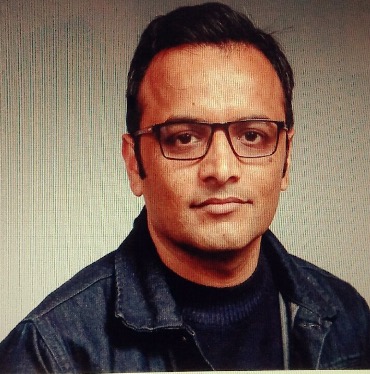
| DrFarooq_writes | |
| ziafarooq@fosstodon.org | |
| Ziaf021 | |
| zia.farooq@umu.se | |
Department of Epidemiology and Global Health, Umeå University, Umeå 901 87, Sweden |
Introduction
I am a data scientist and infectious-disease modeller at Umeå University, Sweden, where I work as a postdoctoral researcher. My work brings together data science, machine learning, and mathematical modelling to understand and anticipate how infectious diseases spread in a changing climate.
Within the EU-funded IDAlert project, I use machine learning and explainable AI to predict outbreaks of complex zoonoses such as West Nile virus and to project their expansion under climate change. My recent first-author work in The Lancet Planetary Health traces the northward expansion of Aedes albopictus and the accelerating risk of dengue and chikungunya in Europe, while my latest study couples spatial-diffusion and time-to-event modelling to explain West Nile virus invasion across the continent. I also develop frameworks that separate the roles of climate change and human mobility in the global spread of dengue, and methods that sharpen disease-severity and case-fatality estimates. As a member of the Lancet Countdown in Europe team, I develop the European risk indicator for West Nile virus.
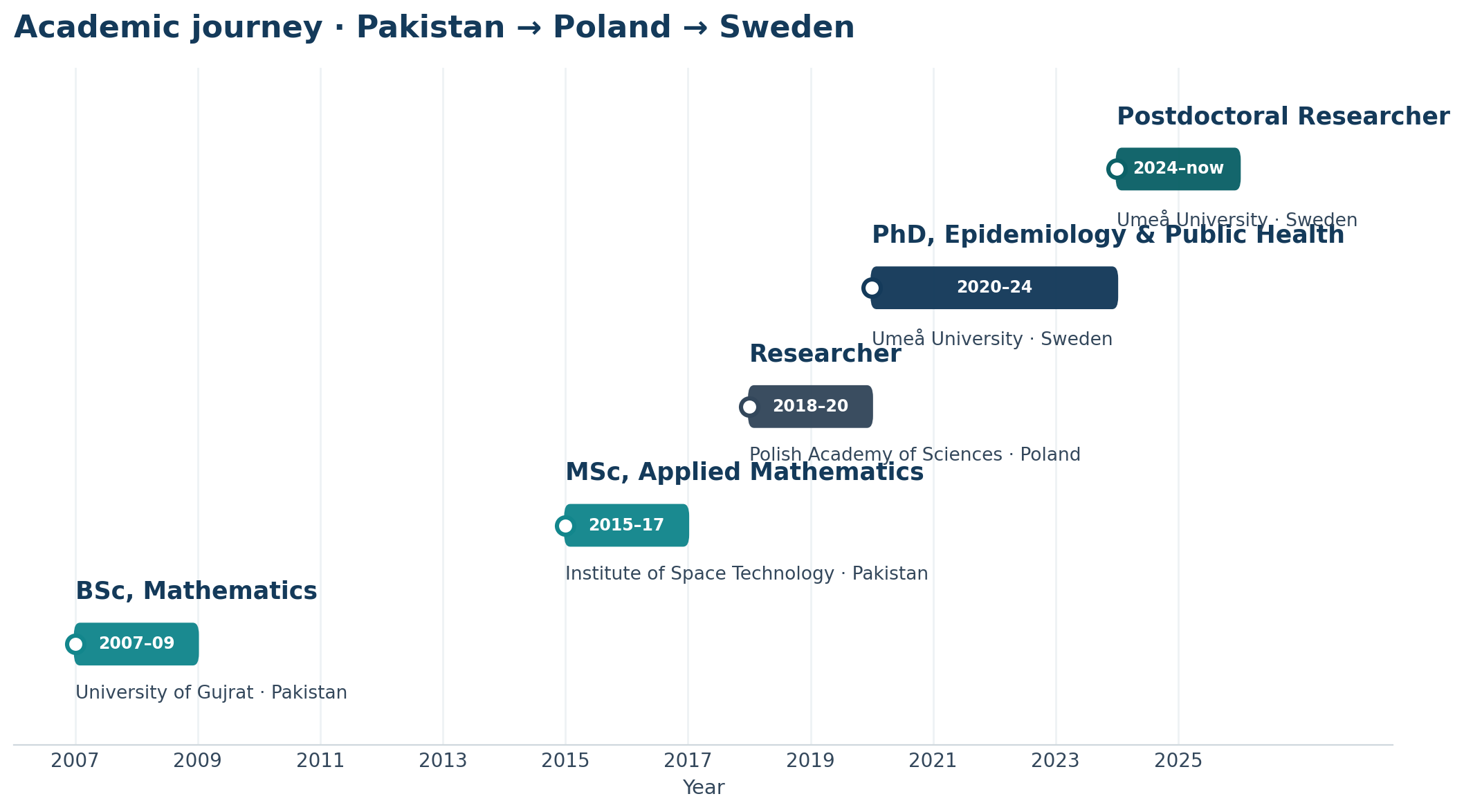
Academic journey
From mathematics in Pakistan to biological modelling in Poland and data-driven epidemiology in Sweden — the path that shaped my research.
Research Interests
My research interests and expertise include:
- Predictive modelling of vector-borne and emerging infectious diseases
- Machine learning, explainable AI, and mechanistic modelling
- Spatial epidemiology, disease risk mapping, and ecological niche modelling
- Climate change, human mobility, and the drivers of disease emergence
- Survival and time-to-event analysis; disease-severity and case-fatality estimation
- Epidemiological data science and reproducible research workflows
Background
Before moving to Sweden in 2020, I spent around a year and a half in Warsaw, Poland, as a researcher at the Institute of Fundamental Technological Research, Polish Academy of Sciences. My earlier training in Pakistan was in mathematics and statistics, so relocating to Umeå marked both a geographical move and a deliberate shift in my research direction — from applied mathematics towards data-driven epidemiology.
Most of the code I wrote during my PhD was in R and MATLAB, and I remain a firmly data-oriented researcher: I routinely collect data through web scraping and APIs, adapt quickly to new tools, and occasionally work on text analysis. I speak English, Urdu, and Punjabi, and work fluently in R (dplyr and the tidyverse) and Python.